
The new standard for building securely
Multi-distro compatibility
Near-zero CVEs
Transparent SBOMs
Provenance you can trust
What makes DHI different
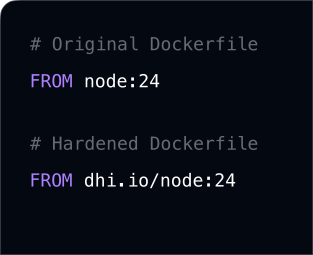
Drop-in Adoption
Swap the base image and get instant security gains.
Apache 2.0 on Open Distros
You can migrate to and from with freedom and without surprises. Pay when you need stronger SLAs, compliance, or to leverage our build service.
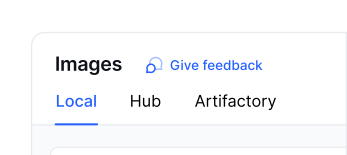
Easiest path to secure supply chain
Drop-in replacements that require minimal changes. Our event-driven build system keeps images continuously updated, and secure customization allows you to tailor hardened images without breaking provenance.
Built with Docker-Maintained
Packages
Every DHI image is built with system packages that Docker builds, patches, and maintains directly from upstream source.
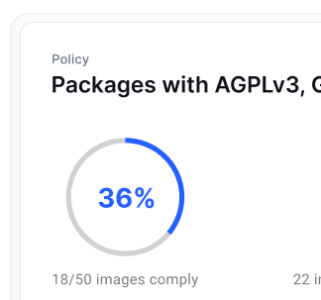
Full Transparency
Signed SBOMs and SLSA Level 3 provenance, with complete CVE data.
Built for Developers, hardened for security
When upstream stops, your protection continues. Up to 5 extra years of hardened patching, SBOMs and provenance.
Security that outlasts upstream
CVE patching continues after upstream EOL
SBOMs and provenance maintained throughout
Covers the images you rely on most: Node, Python, PostgreSQL, and more

Up and running in seconds

“For the first time, I don’t have to worry about what’s hiding in our base images. That mental overhead is gone, and we can finally focus on the security challenges that are unique to Attentive.”
Jacob Rickerd
Principal Security Engineer at Attentive
A complete security model
forward for organizations operating at scale.
Free for every developer
What’s included:
Hardened, minimal images
Near-zero CVEs
Verifiable SBOMs & SLSA Build L3 provenance
Full, unsuppressed CVE visibility
Drop-in adoption, no workflow changes
Full catalog of open source images under Apache 2.0
Built with Docker Hardened System Packages
Upstream cadence for Docker-released patches
Starting at $5k/repo
Everything in community, plus:
FIPS/STIG variants
Critical CVE fixes < 7 days with
SLA-backed continuous patching
Up to 5 customizations
Contact us for pricing
Everything in select, plus:
Unlimited customizations, including system packages
Access to Hardened System Packages repo
Full catalog access available
ELS add-on available
Extended Lifecycle Support
Add onSecurity and compliance for end-of-life software. Requires DHI Enterprise.
+5 years of hardened updates
Maintains security updates after upstream EOL
SBOMs & provenance
Protects long-lived workloads
Trusted by the ecosystem




“Security shouldn’t be a premium feature. By making hardened images free, Docker is letting every developer—not just big enterprises—start with a safer foundation. We love seeing tools that reduce noise and toil, and we’re ready to run these secure workloads on Google Cloud from day one.”
Ryan J Salva
Senior Director of Product, Developer Experiences
“At MongoDB, we believe open source plays a central role in how modern software is built, enabling flexibility, choice, and developer productivity. That’s why we’re excited about free Docker Hardened Images for MongoDB. These images provide trusted, ready-to-deploy building blocks on proven Linux foundations such as Alpine and Debian, and with an Apache 2.0 license, they remain fully open source and free for anyone to use. With Docker Hub’s global reach and MongoDB’s commitment to reliability and safety, we are making it easier to build with confidence on a secure and open foundation for the future.”
Jim Scharf
Chief Technology Officer, MongoDB
“Docker’s move to make its hardened images freely available under Apache 2.0 underscores its strong commitment to the open source ecosystem. Many CNCF projects can already be found in the DHI catalog, and giving the broader community access to secure, well-maintained building blocks helps us strengthen the software supply chain together. It’s exciting to see Docker continue to invest in open collaboration and secure container infrastructure.”
Jonathan Bryce
Executive Director, Cloud Native Computing Foundation
DHI vs. the Alternatives
|
Docker Hardened Images |
Others |
|
|---|---|---|
|
Distro |
Alpine/Debian |
Proprietary |
|
License |
Apache 2.0 |
Mixed |
|
Access |
Free, full catalog |
Trials / paywalled |
|
Adoption |
Drop-in migration |
Requires workflow changes |
|
Security |
Minimal, near-zero CVEs, SLSA Build L3 |
Inconsistent |
|
Transparency |
SBOMs & Provenance |
Partial visibility (suppressed CVEs, proprietary scoring) |
|
Lifecycle |
ELS provides up to 5 years |
Typically ends up to 6 months |
Docker Hardened Images are now available to every developer
Hear how how containers shaped the trust model we rely on today at Docker, and what AI-driven systems mean for the next chapter of software supply chain security.
Watch on demand now
Hardened Images for everyone
Docker Hardened Images are now free and open source under Apache 2.0.
Read
Containers are the new supply chain attack vector
Docker engineers break down the five pillars of supply chain security and why minimal, non-root images are a safer default.
Watch
See Docker Hardened Images Enterprise in Action
Request a demo
Thank you for your interest. The Docker Team will be in touch
FAQ
What are Docker Hardened Images?
Docker Hardened Images are near-zero CVE, secure-by-default, minimal container images designed to serve as a trusted, verifiable upstream for modern software supply chains. Each image is continuously rebuilt from source, reducing attack surface while patching known CVEs as fixes become available rather than on a manual schedule.
The catalog includes thousands of production-ready images spanning runtimes, frameworks, databases, and infrastructure components, with open-source free and commercial tiers available.
Are Docker Hardened Images free?
Yes. The full Docker Hardened Images catalog is free and open source under the Apache 2.0 license. Any developer can pull and use hardened images from Docker Hub at no cost, with no usage restrictions or paywalled catalog access. Because the images are open source and built on standard Alpine and Debian foundations, teams retain full portability with no vendor lock-in.
Commercial tiers (DHI Select and DHI Enterprise) are available for organizations that need assurances such as SLA-backed remediation, compliance-ready image variants, and image customization.
What is the difference between DHI Community, DHI Select, DHI Enterprise, and DHI ELS?
Docker Hardened Images are available in three tiers, each building on the one before it.
- DHI Community is free and open under the Apache 2.0 license. It includes the full hardened image catalog with near-zero CVEs, complete SBOMs, SLSA Build Level 3 provenance, OpenVEX exploitability data, and cryptographic signatures.
- DHI Select adds SLA-backed CVE remediation (critical fixes within 7 days), FIPS-validated and STIG-aligned image variants for compliance requirements, and limited image customization.
- DHI Enterprise expands on Select with unlimited customization capabilities, access to the Docker Hardened System Packages repository for building custom images with the same provenance and patching discipline, and eligibility for Extended Lifecycle Support.
- DHI ELS (Extended Lifecycle Support) add-on provides five additional years of security coverage beyond upstream end-of-life, with continued CVE patches, SBOM updates, and provenance attestations.
What distributions do Docker Hardened Images support?
Docker Hardened Images support both Alpine and Debian, so teams can choose the distribution that matches their existing environment without switching package ecosystems or retraining on unfamiliar tooling.
This matters a lot, because your choice of Linux distribution affects everything downstream: library compatibility, shell scripting, debugging tools, and package management. Docker Hardened Images preserve those foundations rather than replacing them.
How do Docker Hardened Images compare to other hardened image providers?
Docker Hardened Images take a fundamentally different approach by hardening the distributions developers already use rather than requiring migration to a proprietary or unfamiliar operating system. Teams can adopt them as a drop-in replacement with minimal workflow changes, while other providers may necessitate retooling of CI/CD pipelines, debugging workflows, and dependency management.
The Docker Hardened Images catalog is also free and open under Apache 2.0 with no paywalled image versions or usage restrictions. Where other providers may significantly limit the number of images available under free access, or require paid subscriptions for production use, the entire hardened catalog is available to everyone – including for production uses.
Couldn’t I just build my hardened images in-house?
You could, but Docker Hardened Images replace the operational burden of maintaining internal hardening pipelines with a continuously maintained, verifiable supply of production-ready images. Teams that build their own hardened images typically invest significant engineering time in patching, rebuilding, testing, and maintaining SBOMs and provenance for every image in their portfolio.
With Docker Hardened Images, that work is handled by our automated build system, which rebuilds from source whenever upstream fixes become available. Organizations get near-zero CVE images with over 17 complete supply chain attestations that serve the needs of auditors and security teams, without needing to staff and maintain a dedicated image hardening function.
For teams that need to go beyond the standard catalog, the Enterprise tier provides access to the Docker Hardened System Packages repository for building custom images that retain the same provenance and patching discipline.
Do Docker Hardened Images work with Alpine and Debian?
Yes. Docker Hardened Images are built on Alpine and Debian foundations, so they are fully compatible with the tools, libraries, and package managers your team already uses. Teams that rely on glibc (Debian) or musl (Alpine) can adopt hardened images without breaking existing dependencies, shell scripts, or CI/CD pipelines.
Other hardened image providers often use custom or proprietary distributions that can introduce compatibility issues with standard Linux utilities and tooling, and need migration planning to adopt proprietary distros. Because Docker Hardened Images preserve the underlying distribution, adoption typically requires changing just one line in a Dockerfile.
How transparent are Docker Hardened Images about CVE data?
Docker Hardened Images provide complete, unsuppressed CVE data for every image alongside OpenVEX exploitability assessments. Every vulnerability is fully disclosed. The VEX data adds context about whether a CVE is actually exploitable in that specific image configuration, giving security teams the information they need to prioritize based on real-world risk rather than raw scanner counts.
Some providers curate CVE visibility through proprietary CVE feeds, or filter the vulnerabilities they surface, which can mask risk. Docker Hardened Images take the opposite approach: full visibility into every known issue, with exploitability context layered on top so teams can make informed decisions.
What compliance standards do Docker Hardened Images support?
Docker Hardened Images Select and Enterprise tiers include FIPS-validated and STIG-aligned image variants for teams that need to meet federal and industry compliance requirements, including FedRAMP, NIST, and CIS benchmarks.
Every image across all tiers, including the free Community tier, ships with a complete SBOM, SLSA Build Level 3 provenance attestations, a cryptographic signature, and OpenVEX exploitability data. Together, these give auditors and security teams a verifiable record of what each image contains, how it was built, and the ability to cryptographically verify components within the image.
How do Docker Hardened Images handle CVE patching?
Docker Hardened Images use a continuous, event-driven build system that automatically rebuilds images whenever upstream fixes become available. The system scans tens of thousands of CVE notifications across the ecosystem to maintain a near-zero known CVE baseline across the catalog without requiring teams to manage patching themselves.
For organizations on Select or Enterprise tiers, critical CVE fixes are delivered within 7 days under an SLA.
What is Extended Lifecycle Support?
Extended Lifecycle Support (ELS) is an add-on for the Docker Hardened Images Enterprise tier that extends security coverage up to five years beyond a software version’s upstream end-of-life. When upstream patches stop, ELS ensures vulnerabilities are still addressed with hardened updates, maintained SBOMs, and continued provenance.
ELS is designed for organizations that are unable to upgrade on upstream timelines due to regulatory requirements, testing constraints, or operational complexity. It provides a supported path to maintain security and compliance without forcing disruptive version migrations.
Can I customize Docker Hardened Images?
Yes. The Select tier includes limited image customization, and the Enterprise tier provides unlimited customization capabilities along with direct access to the Docker Hardened System Packages repository. This means teams can build custom images using the same hardened packages, provenance, and patching discipline that power the standard catalog.
When a base layer is patched, we automatically rebuild custom images built through the Enterprise customization workflow. This removes the need for self-built CI scripts to keep custom images current, and ensures that custom builds retain the same verifiable supply chain integrity as the rest of the catalog.
Customizations with Docker Hardened Images keep SLSA Level 3 provenance, security attestations, and the Docker SLA intact. The SLA persists automatically through every patch.
How do I migrate to Docker Hardened Images?
Migrating to Docker Hardened Images is designed to be as simple as changing one line in your Dockerfile. Existing libraries, scripts, and CI/CD pipelines typically work without modification because the images preserve the base distribution your team already uses.